
How Visual Arts Connect the Whole Curriculum
Estimated reading time: 6 minutes
Art as a Language-Rich Environment
In every lesson, students are speaking, listening and reflecting. They use sentence starters such as “My artwork shows…” and “I used colour to…”. They describe colours, shapes, patterns and movement. They also discuss artists such as Henri Matisse and Pablo Picasso, building vocabulary through purposeful talk. Even our youngest learners are developing expressive language alongside creative skills. For example, Reception and Year 1 students describe how they “use lines” and “add colour”, gaining confidence as they learn to explain their choices.
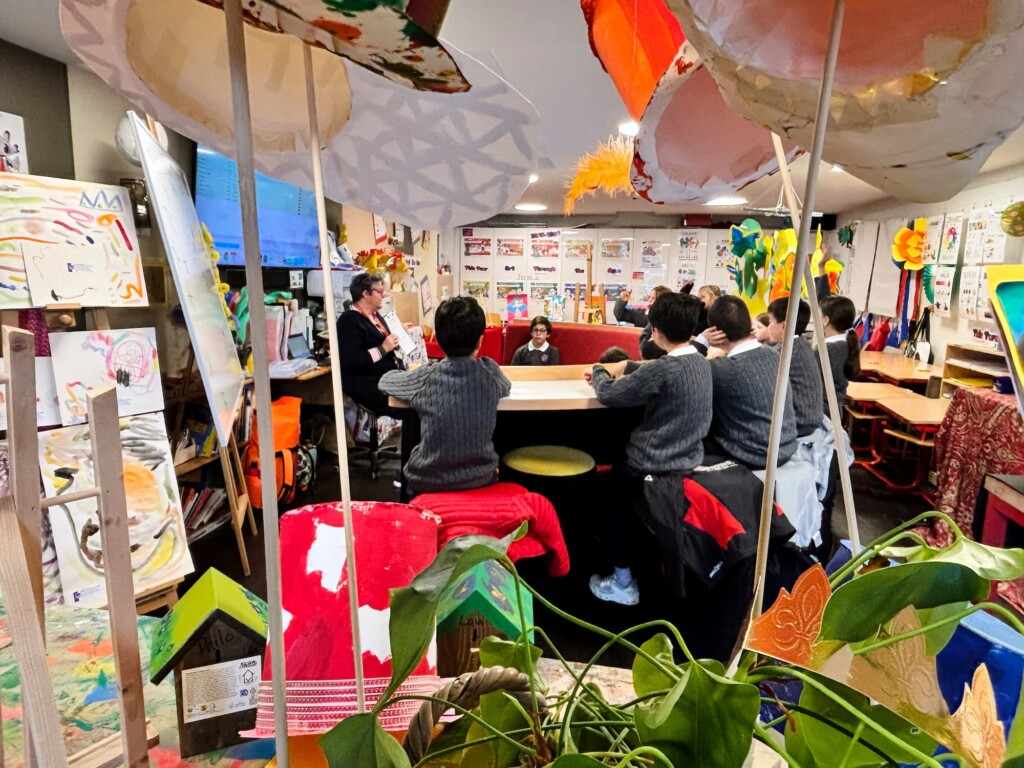
This aligns closely with the work of Lev Vygotsky, who emphasised the importance of language, social interaction and cultural context in children’s learning. In the art room, talk is not an add-on; it is embedded in the making process.
Maths in Every Brushstroke
Visual Arts provides a natural and meaningful context for mathematical thinking. Shape and geometry appear in Cubist drawings, symmetry and balance guide composition, fractions and proportion emerge when students divide space, and pattern and repetition are central to design work.
In Year 3 and Year 4 Cubism lessons inspired by Picasso, students divide objects in their drawings into sections using lines and geometric shapes. They begin by identifying basic forms such as triangles, rectangles and circles within an everyday object, then experiment with fragmenting and rearranging these shapes across the page. Some students count and compare the number of sections they have created, while others discuss how the size of one shape affects the balance of the whole composition.
Younger students engage with maths just as naturally. In Reception and Year 1, cutting and arranging paper shapes introduces early concepts of size, position and spatial relationships, long before these ideas are formally named in a maths lesson. A square placed above a triangle becomes a conversation about “bigger” and “smaller”, “above” and “below”.
Through this process, mathematical ideas are explored visually, practically and creatively. Rather than existing only on a worksheet, Maths becomes visible, tangible and purposeful.
Scientific Thinking Through Art
Art also encourages observation, experimentation and prediction, which are core scientific skills. Students mix colours and explore tints, investigate materials and techniques, and observe how placement affects movement and composition.
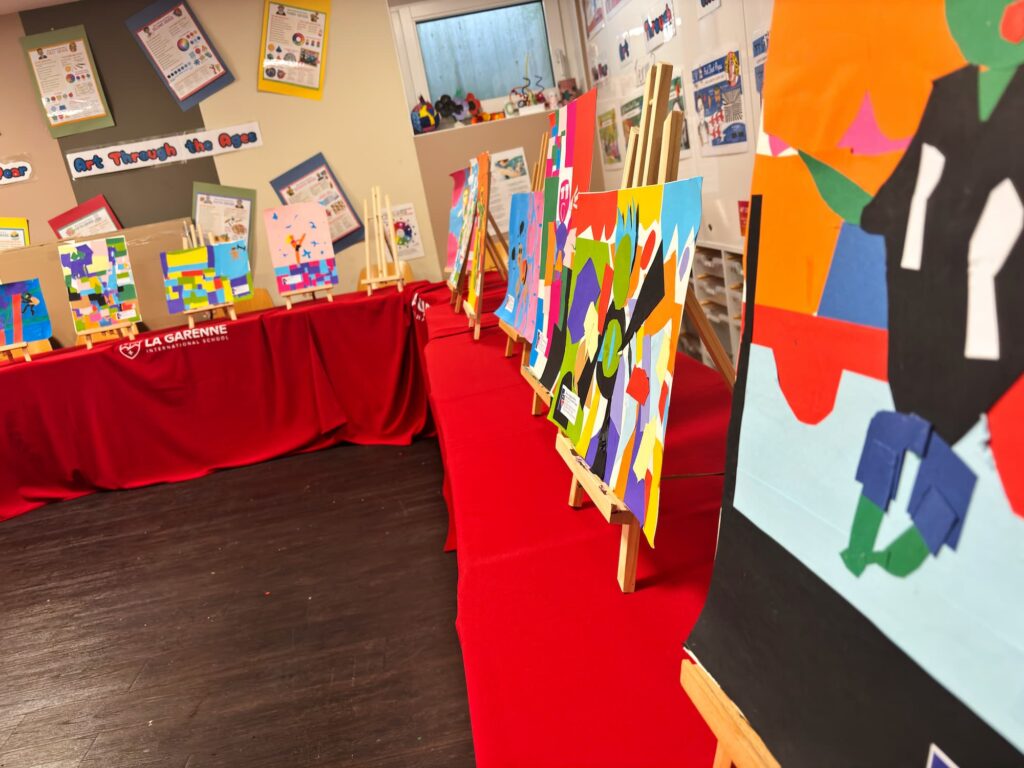
In Year 2, students experiment with colour mixing and contrast in their Matisse-inspired Goldfish paintings. Working with primary colours, they test combinations, record what happens when white or black is added, and compare their predictions with the results. They discover how adding white creates lighter tones, while adding black creates shade and contrast. Some students go further, exploring what happens when they mix two colours in different proportions, noticing that small changes produce quite different results.
This process mirrors the scientific method closely. Students form a hypothesis (what do I think will happen if I mix these colours?), test it through direct experimentation, and observe and record the outcome. The materials themselves, paint, water, brushes and paper, also invite scientific curiosity: why does wet paint behave differently to dry paint? Why does the paper buckle when too much water is used? These are the same questions a science lesson would ask, simply approached through a different material.
This simple act of experimentation, repeated across year groups, builds the habits of curiosity and enquiry that scientific thinking depends on.
Learning Through Doing
Educational research consistently supports the value of learning through experience, reflection and the arts. John Dewey argued that meaningful learning grows from experience, while Elliot Eisner highlighted the role of the arts in developing flexible thinking, interpretation and problem-solving.
In practice, this means students are experimenting, making choices, refining ideas and reflecting on their work. For example, Year 6 students explore multiple perspectives in Cubist portraiture inspired by Picasso. By combining front and side views in one image, they take on an advanced cognitive task involving spatial reasoning, creativity and perseverance. It was much harder than it looked, and more than one attempt was often needed to create a sketch worthy of Picasso’s influence.
The Power of a Real Artwork
The presence of a Matisse cut-out artwork has been a turning point in this unit. Suddenly, learning is no longer theoretical. Students can see scale, texture and colour relationships. They ask deeper questions: How was this made? Why these shapes? What effect do the colours create? They also make stronger connections to their own work. In Year 5, students created compositions inspired by Matisse’s La Danse, arranging organic and geometric shapes to show movement and energy. Having a real artwork nearby elevates this from a simple creative task to an authentic artistic dialogue. It also builds cultural capital. Students begin to see themselves as part of a wider artistic world.
A Truly Holistic Learning Experience
Across year groups, this unit demonstrates how Visual Arts naturally integrates multiple disciplines:
| Area | How it appears in Art |
| Language | Discussion, reflection and vocabulary building |
| Maths | Shape, pattern, proportion and spatial awareness |
| Science | Experimentation, observation and materials |
| Personal Development | Confidence, independence and creativity |
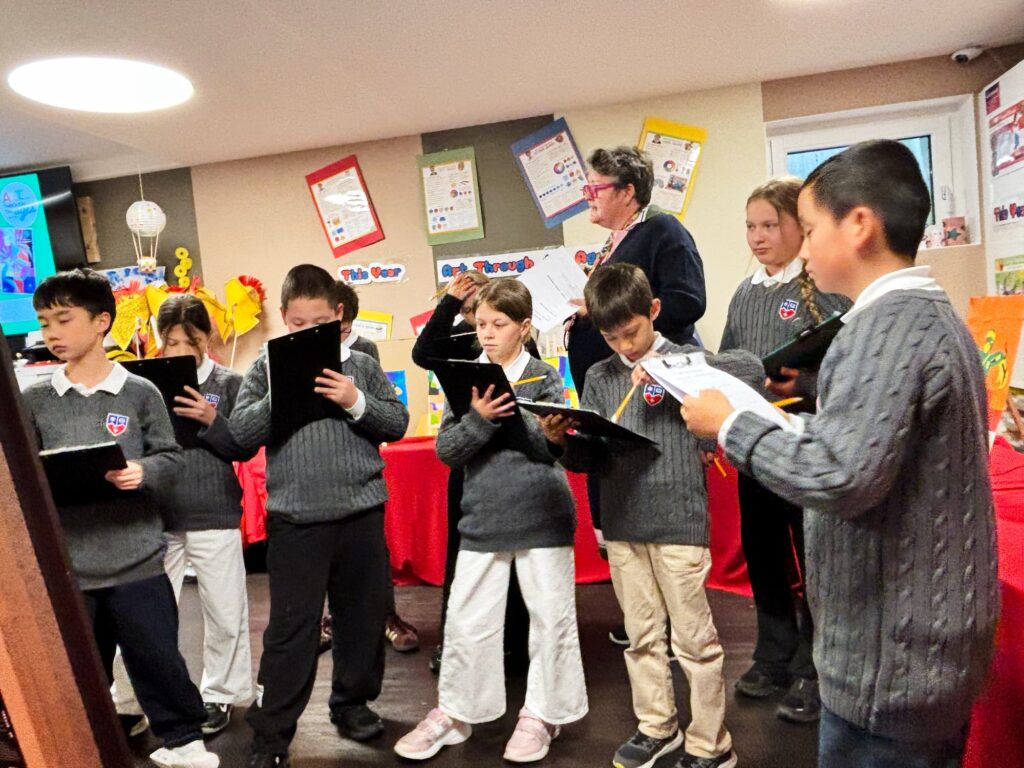
From cutting shapes in Reception to analysing Cubism in Year 6, students are not just making art. They are thinking, communicating, experimenting and problem-solving. Visual Arts is often seen as an “extra” subject. In reality, it is one of the most powerful ways to bring learning together. When a child mixes colour, arranges shapes or reflects on their work, they are not simply being creative; they are building skills that support learning across the entire curriculum. And sometimes, all it takes is a pair of scissors, a splash of colour and a glimpse of a Matisse masterpiece to make that learning unforgettable.
Key Takeaways
- Visual Arts fosters language development, mathematical thinking, and scientific curiosity through hands-on experiences.
- Students actively engage in discussions and reflect on their art, reinforcing their understanding of concepts.
- Incorporating real artworks, like Matisse’s cut-outs, enhances learning by making it more tangible and relatable.
- This holistic approach integrates language, maths, science, and personal development across year groups.
- Visual Arts is not just an extra subject; it is a powerful avenue for building skills that support overall learning.
References
- Lev Vygotsky’s sociocultural theory emphasises the role of language and social interaction in learning and cognitive development.
- John Dewey’s educational philosophy highlights the importance of learning through experience and interaction with the world.
- Elliot Eisner’s work explores what education can learn from the arts, particularly in relation to flexible thinking, interpretation and problem-solving.
- Research on arts integration has shown links with student engagement and long-term retention of learning content.